
Researchers at the John Walton Muscular Dystrophy Research Centre, supported by us, have developed a free online tool that uses artificial intelligence (AI) to help doctors understand complex muscle scans. This could help people with muscle wasting conditions get a faster and more accurate diagnosis.
New AI tool to help doctors diagnose muscle wasting conditions
3 October 2025
The impact of getting a speedier diagnosis
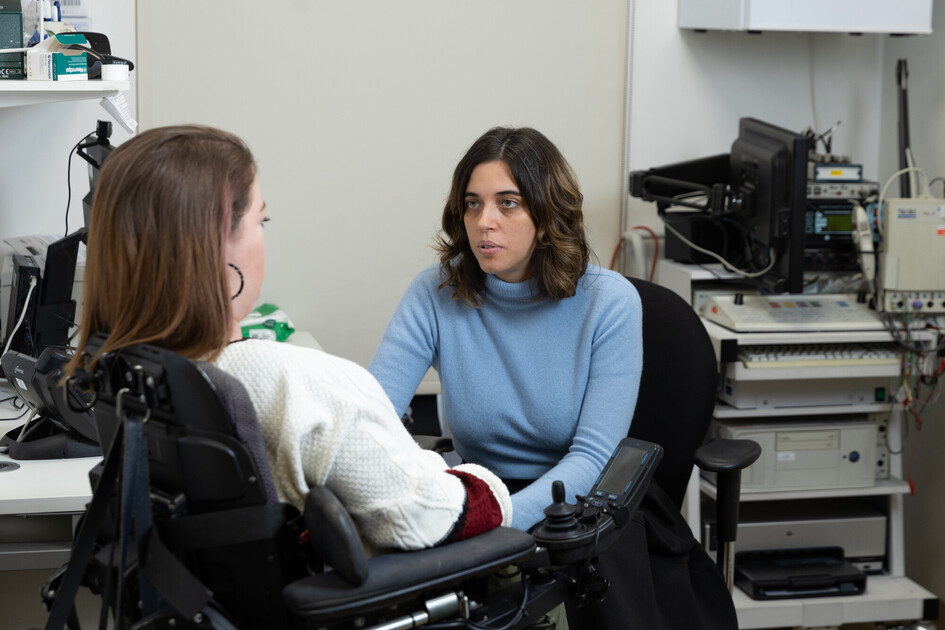
Making the diagnosis process faster and clearer can help families get the support they need sooner. For many families living with muscle wasting conditions, getting a diagnosis can be a long and emotional journey. It’s often confusing and upsetting, especially when answers are slow to come. In many cases, people wait months or even years for answers. An early and accurate diagnosis is important because it helps doctors choose the best tests, treatments, and care.
Using AI to help doctors read MRI scans
Doctors use a type of scan called an MRI to look at muscles. These scans can show when muscle is being replaced by fat or scar-like tissue – a sign of muscle wasting conditions. But reading these scans isn’t always easy. It’s a bit like trying to spot someone in a busy crowd. Different conditions can look the same, so it takes a trained expert to tell them apart.
This new AI tool called Myo-Guide will help doctors read muscle scans more easily. It uses artificial intelligence (AI) to look at how much fat is in the muscles and compares this to patterns from known conditions. This helps doctors make faster and more accurate diagnoses, even when the scans are complex.
Training the AI
To make accurate suggestions, the AI behind Myo-Guide had to be trained – just like how people learn by seeing lots of examples. The more scans it sees, the better it becomes at spotting patterns and making reliable decisions.
The team collected nearly 3,000 MRI scans from 34 clinical sites across Europe, North America and Asia. These scans covered over 40 different muscle wasting conditions. For this first version, they focused on 20 conditions with at least 30 scans each. This included Duchenne muscular dystrophy to rarer conditions.
The team trained the AI to look at the patient’s age at the time of MRI, their sex and how much fat was found in different muscles. The AI then compared this information to thousands of known cases to suggest a diagnosis. It could even highlight which muscles were most important in making the diagnosis. For example, in a condition called sarcoglycanopathy, the AI learned that pelvic muscles are often affected early on – something that muscle specialists also look for.
How well does Myo-Guide work?
When tested on new MRI scans it had never seen before, Myo-Guide got the right diagnosis in 65 out of 100 cases. Some of the conditions are very rare, so there wasn’t as much data for the AI to learn from, which can make it harder for the tool to suggest a diagnosis. The results were measured in a way that ensures the tool works well for common conditions, and rare ones too. This is known as balanced accuracy.
When the AI was allowed to give its top three guesses, the correct diagnosis was included in 85 out of 100 cases.
In a direct comparison with four specialist doctors, Myo-Guide came out ahead. Both the AI and the doctors were asked to suggest three possible diagnoses for each case. The AI got the right answer in 75 out of 100 cases, while the best-performing doctor got 64 out of 100.
While Myo-Guide isn’t meant to replace a doctor, it can act like a second expert opinion – especially in rare or complicated cases.
Free and easy to use for doctors
Doctors can use Myo-Guide for free at www.myoguide.org. They upload scan results (without any personal details), and within seconds they receive a ranked list of likely diagnoses. Each suggestion comes with a clear explanation why the tool made that choice. By making this tool freely accessible, the researchers hope to level the playing field, giving clinics without muscle-MRI specialists access to expert-level insights.
So far, the platform has over 130 users from both research and real-world clinical settings. The team keeps promoting the tool and actively includes user feedback to improve it.
What’s next?
Myo-Guide has already shown it can help doctors find muscle conditions faster and more accurately. Now, the team is working on ways to make it even better – and we’re proud to be funding this next stage of the project.
Here’s how the team plan to make the tool more powerful:
- Analyse upper‐body scans: most research has focused on lower-body muscles, where there’s enough data to train the AI. Now, the team wants to expand to include upper-body scans, which could provide key information for certain conditions.
- Add measures of inflammation: some MRI scans can identify muscle inflammation – an early warning sign in some conditions. By adding this data, the tool could spot conditions even earlier.
- Add more patient information: future versions of Myo-Guide will include things like muscle strength test results, giving doctors a fuller picture to work from.
- Detect unusual patterns: Myo-Guide may also help flag scans that don’t match any of the conditions it was trained with. This could help doctors look for other possible conditions.
By supporting doctors to understand MRI scans, Myo-Guide has the potential to help people get answers faster – and start exploring care and treatment options sooner.
Thanks to Jose Verdu Diaz, Carla Bolano Diaz, Sam Fitzsimmons, Alejandro Gonzalez Chamorro, Jessie Trueman, and Jordi Diaz Manera for their support in writing this article.
More news

Major £1.5m funding boost into muscle wasting conditions
September 2, 2026

Funding new research to understand the scale of neuromuscular conditions
August 18, 2026
A decade of progress: from zero to ten treatments for muscle wasting conditions
May 27, 2026