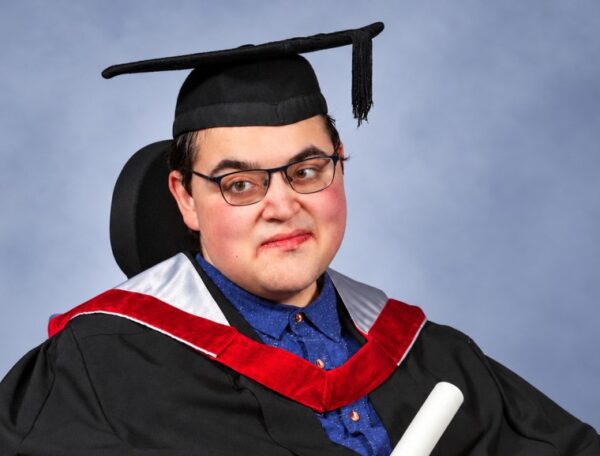
David is a retired veterinary surgeon living with inclusion body myositis (IBM). He shares how the condition has progressed, the support that keeps him connected, and why research offers hope for people diagnosed in the future.
“I hope research will give people with inclusion body myositis a better future”

I spent my career as a veterinary surgeon, specialising in the health and productivity of dairy cows. My work eventually took me to the Royal (Dick) School of Veterinary Studies in Edinburgh, and I was fortunate to travel around the world talking about my specialism. I moved to Scotland around 40 years ago after living in Australia for two years, but I’m originally from Yorkshire.
I’m grateful that a junior doctor recognised the signs
My symptoms emerged soon after I retired, around 10 to 15 years ago. I first noticed that walking uphill was becoming difficult, especially on the slope in my garden. A routine blood test then showed a very high creatine kinase level, and I was told to stop taking statins for my heart disease immediately.
When I was referred to hospital, a junior doctor examined me and wondered whether I had inclusion body myositis. I’m grateful he spotted the signs, as I know now that not many doctors have even heard of the condition. Further specialist appointments and a biopsy confirmed the diagnosis.
Progression is the hardest thing
The progression of my condition has been tough. I can’t stand anymore, so I’m either in bed or in a chair and need to be hoisted to move around. My left hand is now unusable and my right hand is weakening too. I do exercises, but it’s so disheartening when you continue to deteriorate.
It’s also hard when there’s such uncertainty around how to help yourself. One time, I was in hospital for nearly three months after a fall. When I left, I was advised to continue physiotherapy, but be careful not to do too much.
“I’ve not seen a consultant in person for a couple of years, although I occasionally speak to the team by phone and they try to be supportive, it still feels like I’m doing it on my own.”
My family and neighbours are a great support
My wife and I married in 1963 after meeting as students in Cambridge. She was Swiss and had come to improve her English. We had a truly wonderful marriage, and I get emotional every time I think about it. She died at the beginning of this year while I was still in hospital recovering from my fall. She wasn’t particularly well either, so we had to speak on the phone rather than her trying to make the difficult journey to visit, and we talked three or four times a day. She died before I was able to come home from the hospital. Losing her has left a huge hole in my life.
I have two carers visit four times a day to help with my physical needs. My nearest family members live about 40 miles away, but they all make a great deal of effort to visit me.
“I have three children, five grandchildren and six great-grandchildren, and usually see one or two family members most weeks. My good neighbours also pop in for a chat regularly. I appreciate that support enormously.”
Research would give people with less well-known muscle wasting conditions hope
What I want most is greater awareness and more research into IBM. Most people have never even heard of it. A researcher I know had been preparing a treatment trial, but difficulties obtaining a placebo were followed by the withdrawal of funding, and the trial didn’t go ahead, which I found deeply disappointing.
I’ve received support from Muscular Dystrophy UK over the years, including help from Tricia, my local Advocacy and Community Support Worker, with benefits and financial allowances. My hope now is a simple one; that IBM receives the attention it deserves, and that research creates the possibility of treatment for those who come after me.