In recognition of Becker Awareness Week, Ryan shares his experience of the condition, how it’s impacted him emotionally, and how he’s found adaptions to help look after his child. He also discusses the positive impact connecting with the muscle wasting community has had on him.
“Adjusting, adapting, carrying on” — my journey with Becker muscular dystrophy
Becker affects people differently, and for me, the impact varies from day to day. During the week, things feel relatively normal — I get up, drive to the office, sit at my desk, and then drive home. That routine is fairly manageable.
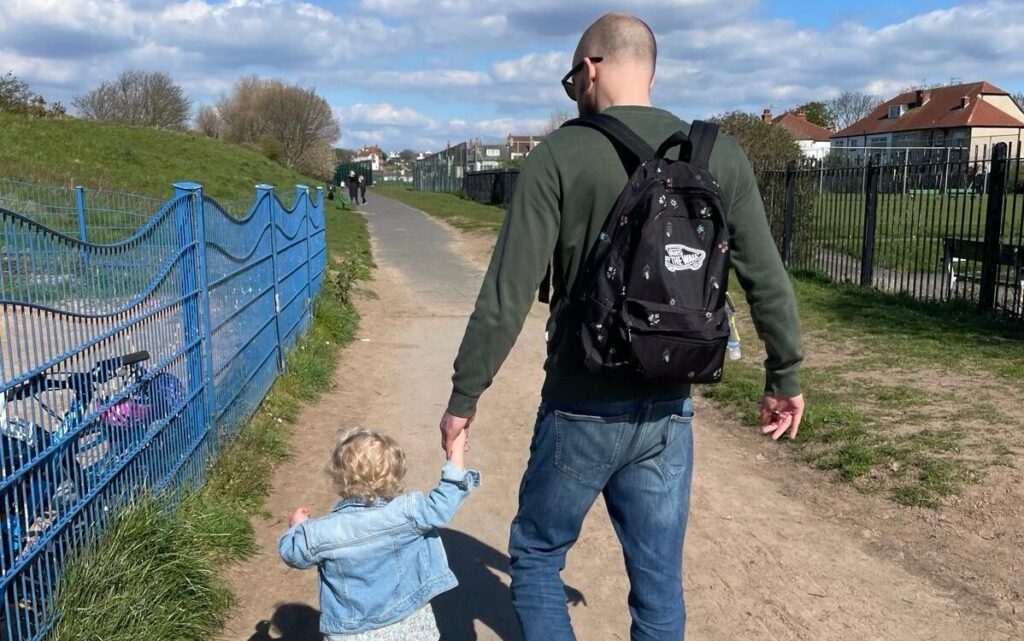
But weekends are when I notice the limitations more. I have to be mindful of how much I do in a day. Even if I feel alright in the moment, I know I’ll likely pay for it the next day. And with a four-year-old, I often have to plan carefully or make compromises.
If we’re going somewhere new, like a zoo or a park, I do research in advance to check accessibility and how far I’ll need to walk. I can still walk short distances on flat ground, but if it’s uphill or a longer stretch, I take my mobility scooter. Sometimes it’s just not worth exhausting myself when I know I’ll need the energy later.
Coming to terms with my diagnosis
I was diagnosed with Becker muscular dystrophy when I was 21. At the time, I didn’t fully understand the long-term implications. The diagnosis made sense of things from my childhood, like why I was never good at sports or running, but it also came with a lot of uncertainty.
For a long time, I didn’t really talk about it. Not with friends, not with family. When I met my wife, she was surprised how little it was discussed in my family, but that was partly on me. It’s not an easy thing to open up about. In the last couple of years though, that’s changed. I think getting older plays a part as you start to care less about what people think. But also, it’s just become more important to me to connect. That’s where Muscular Dystrophy UK has really made a difference.
Finding my community with Muscular Dystrophy UK
I found out about Muscular Dystrophy UK through my mum, and I’ve been involved in a few ways since. I’ve been a peer support volunteer for the last couple of years, which has been incredibly rewarding. Sometimes people reach out for help but then feel overwhelmed or unsure how to continue the conversation so there’s a lot of listening, asking open questions and just being there.
I’ve also taken part in the virtual therapeutic support group for men which was a six-week Zoom programme where we discussed our experiences and challenges. I recently attended a Treat-NMD event in Newcastle which was Becker-specific. Meeting others who live with the same condition is great and it’s good to hear how they manage daily life, family and work.
I’m in a WhatsApp group too, and there are a few people I now regularly chat with. One lives nearby, and we’re at a similar stage in terms of condition progression. It’s comforting to talk to someone who gets it (and has a shared music taste).
Parenting with Becker
Being a parent with Becker comes with its own set of challenges. When my daughter was a toddler, I had to think creatively about how to manage things like lifting, carrying, or chasing after her when she ran off – all the things you take for granted when you don’t have muscle weakness.
I found some solutions by repurposing existing aids like a pillow that wraps around your body to support your arms when holding her, or a soft blanket with handles to help lift her without bending over. These things weren’t designed for disabled parents, but they helped. That said, there’s definitely a lack of information and resources out there for parents with mobility issues. I’d love to see more support in this area.
Living with awareness and resilience
I’m currently recovering from a fall where I tore a tendon in my knee a couple of weeks ago. I’m lucky it’s healing, but it’s a reminder of how precarious things can be. With Becker, you’re always one fall away from something life changing.
That’s made me far more aware of my surroundings and forced me to think seriously about when it might be time to rely more on mobility aids. It’s a constant balancing act between wanting to stay as mobile as possible but also needing to be safe.
I think one of the most important things this condition has taught me is resilience. I used to feel quite isolated with my diagnosis. But now, through sharing and connecting with others, I’ve found a way to be more open and comfortable with it.