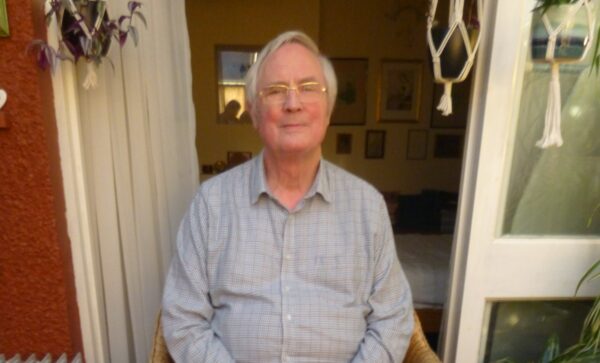
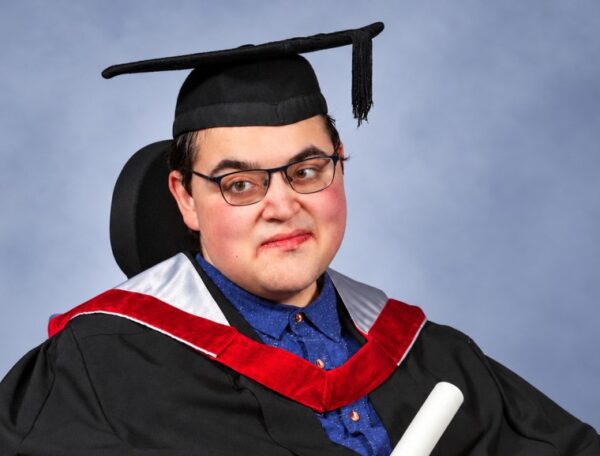
Simon joined our Board of Trustees in February 2026. This Trustees’ Week, we spoke to him to ask what motivated him to take on the role, how his personal experiences as a consultant cardiologist and parent of someone who lived with Duchenne muscular dystrophy have shaped his perspective on patient care, and his hopes for the future.
“Having Matthew as a son made me a better doctor”: Meet one of our Trustees, Professor Simon Ray

In February 2026, Professor Simon Ray became a member of our Board of Trustees. Recently retired from clinical practice, Simon is the National Clinical Director for Heart Disease for NHS England and worked as a Consultant Cardiologist at Manchester University Hospitals.
Alongside his professional expertise, Simon brings lived experience to his Trustee role as his younger son Matthew lived with Duchenne muscular dystrophy and sadly died in September 2024, aged 24. Simon took part in the London to Brighton cycle ride for us last year in his son’s memory, raising over £1,600. He talks to us about his personal and professional experiences and why he wanted to join us as a Trustee.
You joined our Board of Trustees earlier this year. What motivated you to join us and take on the role?
It’s both professional and personal.
In the late 90s, early in my consultant career, I became involved in a service set up to provide cardiology support to people with neuromuscular conditions who were at risk of developing heart problems. It quickly became clear to me that joined-up care was, and still is, something the NHS struggles to provide.
Then, in 1999, our younger son Matthew was born. My wife and I, both doctors, knew early on that something wasn’t right. He was very floppy and slow to walk, and we suspected a congenital muscle condition. Matthew was diagnosed with Duchenne muscular dystrophy when he was two and a half.
Although we had our suspicions, receiving the diagnosis was devastating. No amount of medical knowledge changes that.
Matthew died two years ago, and I remember him as a devoted Manchester United fan and a bright young man who was fascinated with the world around him – he was studying for an Environmental Science degree with the Open University when he died.
When I learned about the Trustee opportunity at Muscular Dystrophy UK, it was the charity’s ten-year strategy that inspired me to apply. The commitment to transforming lives and ensuring no one faces their journey alone really resonated with me. We would have benefited enormously from services like today’s new diagnosis referral programme when Matthew was diagnosed 25 years ago.
As both a cardiologist and the father of someone who lived with Duchenne muscular dystrophy, how has your personal experience shaped your perspective on patient care?
Our experience as a family included both excellent and not-so-good interactions with healthcare services.
Looking back to the time of Matthew’s diagnosis, many professionals were outstanding. In particular, the genetics team were compassionate and understood the impact his diagnosis would have not only on Matthew, but on our whole family.
However, other experiences were less positive. One memory that has always stayed with me is taking Matthew for an echocardiogram when he was about 10 years old. The clinician performing the scan never looked up or spoke to us when we entered the room. It sounds small, but it highlighted how much even basic human interaction matters to patients and families.
“Having Matthew as a son made me a better doctor.”
As Matthew grew up, I became increasingly involved in the cardiac care of adults with muscle wasting conditions. It quickly became clear that services were often fragmented and poorly coordinated.
Because I was also experiencing those challenges as a parent, I think I understood the frustrations patients faced, from travelling long distances to attending multiple appointments on different days. While the system was far from perfect, my colleagues and I worked hard to make care more joined up. For example, trying to ensure that investigations and clinic appointments were scheduled for the same day to reduce the burden on families.
What do you see as the biggest opportunities to improve care for people living with muscle wasting conditions?
One area that should never be underestimated is the importance of personal interaction. A little empathy and communication can make a huge difference to how people experience care. It doesn’t solve every challenge, but it helps people feel supported rather than isolated.
Beyond that, care coordination remains a major opportunity for improvement. This is especially true during the transition from paediatric to adult services. Whenever possible, appointments should be organised so individuals can see multiple specialists on the same visit. Too often, care remains fragmented, creating additional stress and practical difficulties for families.
Diagnosis is another area where progress is needed. Although there have been positive developments, including the campaigning work on newborn screening for spinal muscular atrophy (SMA), many people still face delays in receiving a diagnosis, particularly those where the early signs of the condition are less obvious.
By improving awareness and education among healthcare professionals, we can help ensure people receive earlier diagnoses and faster access to support.
What are your hopes for the future?
Alongside improving care coordination, I have a longstanding interest in research. While most of my work has focused on heart disease, I’m encouraged by the growing number of research projects aimed at improving understanding, treatments and quality of life for people living with muscle wasting conditions. Continued investment in research gives me real hope for the future.
I would also like to see greater flexibility in practical support. One of the frustrations we experienced while Matthew was growing up was around organising adaptations at home. The process often felt rigid and slow. In future, I hope support systems become more responsive to individual needs.
Finally, there is still a lack of understanding about muscle wasting conditions, which can influence attitudes and experiences. Awareness matters, not only in healthcare but also in schools, workplaces and communities. Sometimes improving quality of life comes down to helping the people around an individual better understand their condition.
If we continue educating others and raising awareness, I believe we can drive meaningful change.
What do you hope to bring to the role as a Trustee of Muscular Dystrophy UK?
I don’t think my experience is unique, but I think it is a bit unusual.
Since joining the Board, I’ve learnt a lot about aspects of neuromuscular conditions that I didn’t know. Throughout my career, I’ve looked at things through a heart-shaped lens, so I’ve benefitted from learning more about the wider challenges facing people and families.
What I hope to bring is a commitment to compassionate, person-centred care. I’m passionate about better coordination of services, greater awareness of muscle wasting conditions, faster and more accurate diagnosis, and the continued advancement of research.
I hope that, during my time as a Trustee, I can help drive progress in these areas and support Muscular Dystrophy UK’s mission to create a world without limits for people living with muscle wasting conditions.
We are grateful to Simon, and all our Trustees, for their continued commitment and support.
As a registered charity, we’re governed by a Board of Trustees. They support our Chief Executive and Senior Leadership Team to make sure the charity is run properly – upholding our values, achieving our purpose, and ensuring money is used wisely.
Find out more about our Board of Trustees