We attended the 19th UK Neuromuscular Translational Research Conference on the 17 to 18 April 2026 at the University of Cambridge, where researchers and clinicians from around the world gathered to share the latest developments in neuromuscular research.
The latest research into muscle wasting conditions at the 19th UK Neuromuscular Translational Research Conference
22 May 2026
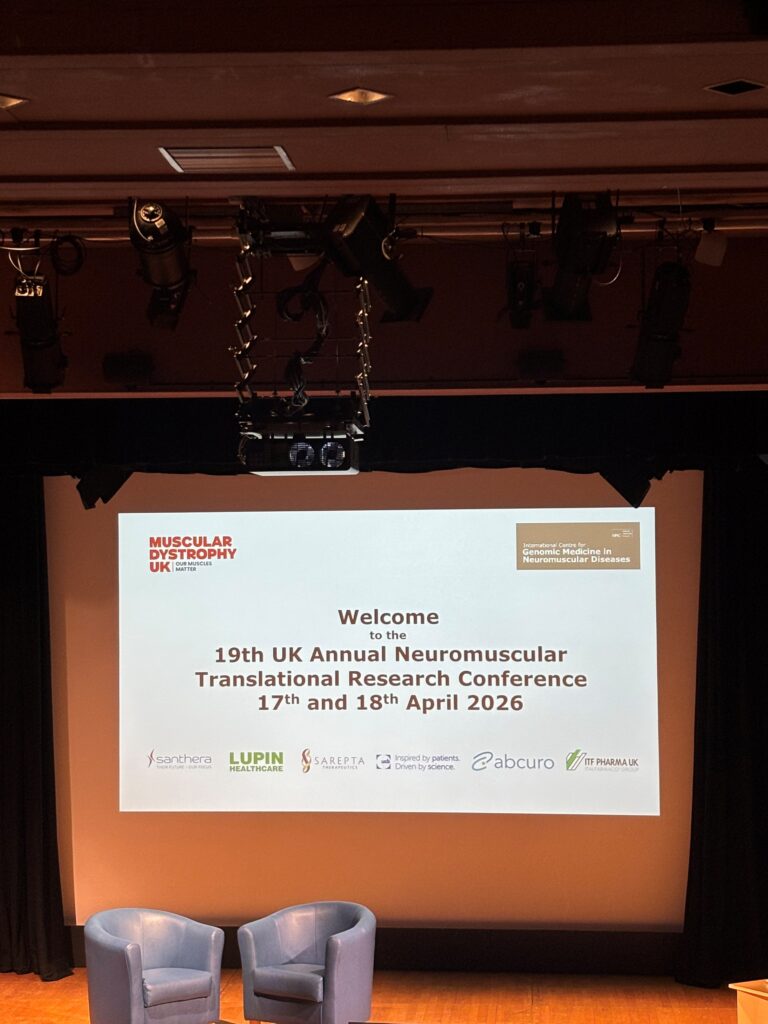
These conferences are an important opportunity for researchers to connect, exchange ideas and build collaborations that help move research forward.
Across two days, talks and poster sessions highlighted progress in genetics, biomarkers, therapies and preclinical research for muscle wasting and weakening conditions. We share some of our highlights.
Advances in gene therapies and new treatments
Researchers at the conference shared progress towards new treatments for muscle wasting and weakening conditions, including gene therapies and more personalised medicines.
Professor Scott Harper, from the Nationwide Children’s Hospital and Ohio State University College of Medicine in the USA, presented research into a potential gene therapy for facioscapulohumeral muscular dystrophy (FSHD). This approach aims to “switch down” the activity of harmful genes that damage muscles. You can think of it a bit like turning down the volume on a faulty speaker that is causing disruption. While still in the early stages, researchers hope this could one day help slow muscle weakness in people with FSHD.
Medical Research Committee Member Professor Richard Piercy, from the Royal Veterinary College, discussed using animal models of Duchenne muscular dystrophy (DMD) to test potential treatments. Animal models help researchers understand how a condition develops and whether treatments are safe and effective before they move into human clinical trials. In many ways, they act as an important stepping stone between laboratory research and treatments being tested in people.
Other talks explored personalised treatments for people with very rare genetic changes. Dr Sara Aguti, from UCL Queen Square Institute of Neurology, discussed therapies being developed for some forms of centronuclear and myotubular myopathy. These treatments are designed to target specific mistakes in a person’s genetic code, almost like using a spellchecker to correct a typo in an instruction manual. Researchers hope these highly tailored approaches could lead to more personalised treatments in the future.
Professor Tobias Ruck, from the BG University Hospital Bergmannsheil Bochum in Germany, highlighted emerging treatments for myasthenia gravis (MG). These treatments aim to calm parts of the immune system that mistakenly attack the body’s own muscles and nerves.
Developing better biomarkers
Several sessions focused on biomarkers. Biomarkers are measurable signs in the body that can help doctors diagnose conditions or track how they change over time. They work a bit like warning lights or fuel gauges in a car, giving doctors clues about what is happening inside the body.
Professor Werner Stenzel, from the Charité University Hospital Berlin, explored whether blood tests could help doctors monitor myositis more accurately. Better biomarkers could help doctors understand whether a condition is staying stable or getting worse, and whether treatments are having an effect.
Researchers also presented work on limb girdle muscular dystrophy (LGMD). Carla F. Bolaño Diaz, from Newcastle University, shared research tracking changes in muscles over time in people with dysferlin-related LGMD, also known as LGMD R2. Finding reliable ways to measure changes in muscle health could also help speed up clinical trials by making it easier to tell whether a treatment is working.
Dr Andrew Frey, also from Newcastle University, discussed new ways of diagnosing mitochondrial disease by analysing proteins in the body. Proteins are the body’s “working parts” that carry out important jobs inside cells. By studying changing patterns in these proteins, researchers may be able to spot signs of disease that current tests can miss.
Improving understanding of rare genetic conditions
Genetics was a major focus throughout the conference, with researchers sharing discoveries that could improve diagnosis and understanding of rare muscle wasting and weakening conditions.
Professor Helen Firth, from the University of Cambridge, presented findings from a large genetics study that has helped researchers identify the causes of many rare developmental and neuromuscular conditions. Finding the genetic cause of a condition can help families get clearer answers about diagnosis and may guide future treatment and care.
Dr Nicola Whiffin, from the University of Oxford, also discussed how researchers are studying lesser-known parts of our genetic code. Although these parts do not directly make proteins, they can still affect how genes work, a bit like punctuation changing the meaning of a sentence.
Supporting researchers and collaboration
The conference also gave early-career researchers (ECRs) the opportunity to present their work through talks and poster sessions. There was even a dedicated session for ECRs to learn more about careers in industry and to network with one another.
We are committed to support ECRs to take part in this conference. One way we do this is through the MDUK UK Prize, which awards £500 to the best talk to help fund attendance at a future conference. Pambos Demetriou, University College London, won this year’s prize for their work on neurodevelopmental brain defects associated with spinal muscular atrophy (SMA).
Conferences like these are an important way for researchers and clinicians to share ideas, build collaborations and accelerate progress towards better diagnosis, treatments and care for people living with muscle wasting and weakening conditions. We are proud to have once again partnered with colleagues at UCL to help support this year’s UK Neuromuscular Translational Research Conference.

This meeting is sponsored/financially supported by these companies. The companies/organisations had no input or influence on the educational content or agenda of this meeting.
More news
Major £1.5m funding boost into muscle wasting conditions
September 2, 2026
Funding new research to understand the scale of neuromuscular conditions
August 18, 2026
A decade of progress: from zero to ten treatments for muscle wasting conditions
May 27, 2026