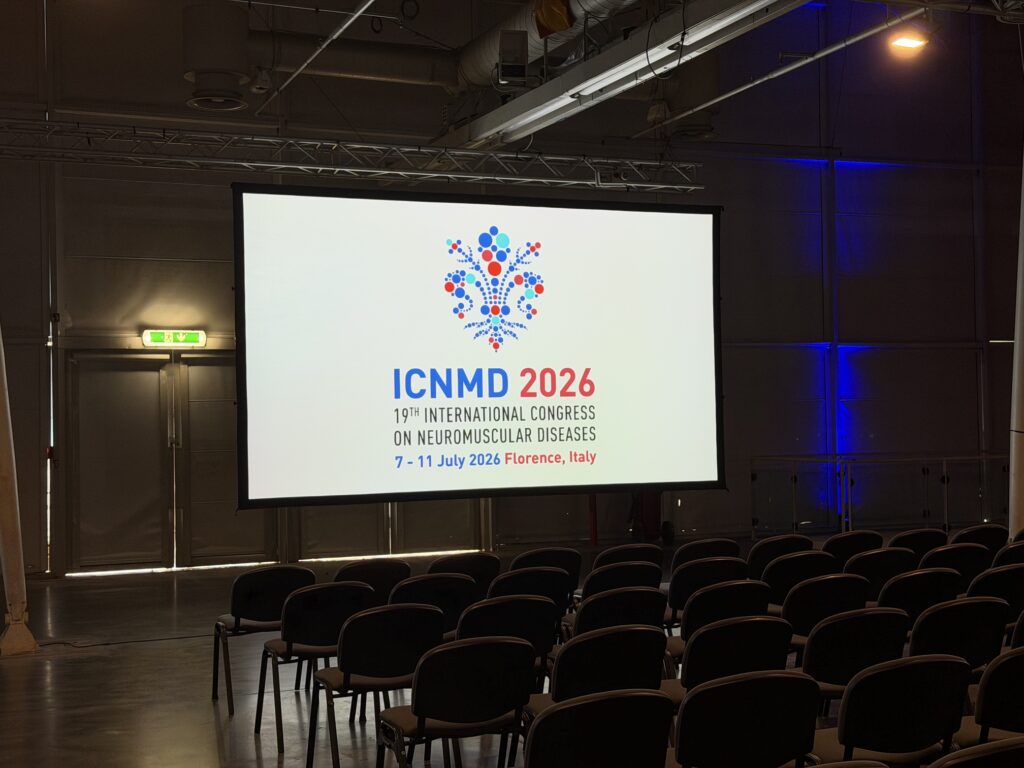
Last week, Muscular Dystrophy UK attended the International Congress on Neuromuscular Diseases (ICNMD) in Florence, bringing together researchers, clinicians, industry and patient organisations from around the world.
Looking ahead: what could neuromuscular care look like in 2030?
21 July 2026
What we found out
One message came through loud and clear: there is real momentum across the field of muscle wasting research.
Researchers shared advances in areas including Duchenne muscular dystrophy (DMD), Becker muscular dystrophy (BMD), spinal muscular atrophy (SMA), myasthenia gravis, congenital myasthenic syndromes, FSHD, myotonic dystrophy, limb girdle muscular dystrophies (LGMD) and other muscle and nerve conditions. Exciting developments are helping to improve diagnosis, track disease progression more accurately and support the development of new treatments.
Looking ahead to the future
Many speakers looked ahead to what neuromuscular care could look like by 2030. Future advances could include:
- Faster and more accurate genetic diagnosis
- More personalised treatments based on an individual’s genetics
- New biomarkers to help measure disease progression and treatment benefit
- Greater use of digital technology and wearable devices to monitor health at home
- Earlier treatment and intervention
Artificial intelligence (AI) was another major theme, with researchers exploring how it could help identify patterns in complex data, speed up diagnosis and improve the design of clinical trials.
Alongside the science, we spoke with researchers, clinicians and companies about the importance of ensuring that new treatments can reach the people who need them. Scientific breakthroughs are only part of the journey. Access to treatments, NHS capacity and robust evidence of benefit will all play an important role in determining how quickly new therapies become available in practice.
It was also a great opportunity to meet many Muscular Dystrophy UK-funded researchers and clinical partners and hear first-hand about the progress being made across the UK.
The overall feeling from the conference was one of cautious optimism. While there are still challenges ahead, the pace of progress in neuromuscular research is encouraging, and there is growing hope that advances in diagnosis, care and treatment will continue to improve the lives of people living with muscle wasting conditions.
More news
Listening to the SMA community: how patient experiences are helping shape treatment decisions
September 22, 2026

Phase 2 trial of PGN-EDODM1 for DM1 advances
August 11, 2026
First patient receives treatment in new gene therapy trial for XLMTM
May 5, 2026