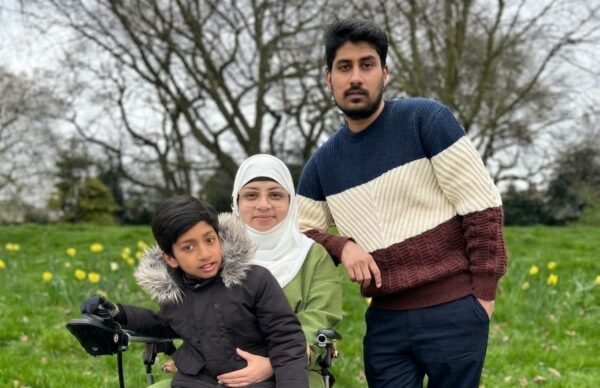
Leeza explains her journey living with congenital muscular dystrophy type 1A, including her experience of education and travel.
More than my diagnosis: my journey of resilience, independence and possibility

Growing up different, but never limited
Living with congenital muscular dystrophy type 1A has shaped my life in many ways, but it has never defined what I can achieve. I come from a Pakistani heritage and have grown up surrounded by a loving family and strong cultural values that have taught me resilience, determination and the importance of never giving up. Living with muscular dystrophy has meant facing challenges that many people may never have to think about, particularly when it comes to mobility, independence and everyday life. However, throughout my life, I have always tried to find my own way of doing things and become as independent as possible.
Finding my place in a mainstream school
Attending a mainstream school was an important part of my childhood. Being physically different sometimes meant that everyday things were more difficult, from getting around school and taking part in PE to joining activities and keeping up with the pace of school life. However, my parents played a huge role in ensuring that my disability never became a barrier to my education or experiences.
My parents were my biggest advocates. They worked with my school to find solutions rather than accepting that I could not participate. They taught me that needing something adapted did not mean I was incapable; sometimes I simply needed to do things differently.
Seven spinal surgeries: overcoming setbacks
One of the biggest challenges I have faced has been undergoing seven spinal surgeries. Recovery was difficult, but I continued working towards my goals and refused to let these experiences stop me moving forward.
Education and building my independence
Education has been one of my proudest achievements.
“Despite the challenges of muscular dystrophy and recovering from surgeries, I completed a degree in health and social care and graduated with a first-class degree. It was proof that my disability does not have to determine the limits of my future.”
I have also built a career as a special educational needs worker and created a life I am incredibly proud of. For me, independence means making my own choices and finding ways to do things for myself.
Seeing the world: travelling with muscular dystrophy
Travelling has been another important part of my journey. I have been fortunate enough to travel around the world, experience different cultures and create some of my happiest memories. Travel has shown me that having muscular dystrophy does not have to mean limiting the life I want to live. It often requires more planning, patience and flexibility, but I have never wanted my condition to become a reason to stay at home or miss out.
The reality of accessible travel
Accessible trains and buses, particularly in some European countries, have made it possible for me to explore places I might otherwise have struggled to reach, giving me a real sense of freedom and independence.
However, travel is not always straightforward. Finding suitable accommodation can be difficult because a room described as “accessible” may not meet my individual needs. Bathrooms and showers can be particularly challenging, and there have been holidays where my family have had to find practical solutions to help me manage.
Air travel has also presented challenges. I use an electric wheelchair every day, but I have experienced situations where airlines have said it is too large to accommodate. Because my wheelchair is such an important part of my independence, this can be disappointing. I now sometimes travel with a manual wheelchair instead. It is not my preferred option, but I have learned to adapt because I do not want these barriers to stop me seeing the world.
My parents: the reason so many adventures were possible
My parents have been a huge reason why I have been able to travel as much as I have. They have helped me plan, problem-solve and adapt when things went wrong.
“They have never made me feel that my disability should stop me experiencing the world. Instead, they have helped me find ways around obstacles and have allowed me to see places I once only dreamed of visiting.”
My disability is part of my story, not my whole story
Travelling has taught me to be adaptable, patient and prepared, but most importantly, not to let accessibility barriers define what I can and cannot do. There have been painful, frustrating and exhausting moments, but these experiences have also taught me resilience. I have learned that independence can look different for everyone and that asking for support does not take away from independence.
I want to share my story to encourage other young people living with muscular dystrophy, particularly those from backgrounds where disability may not always be openly discussed. A diagnosis can be part of your story without becoming the whole story.
I am proud of everything I have overcome — from surgeries and health challenges to completing my degree with a first-class result, building a career, becoming as independent as possible and travelling the world. I still have ambitions for the future, and I intend to continue living my life on my own terms.