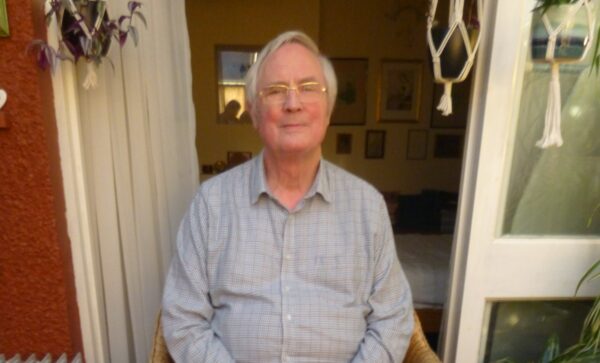
Ian was diagnosed with Facioscapulohumeral muscular dystrophy (FSHD) in his twenties. His diagnosis meant an unexpected turn in his life as he lost the profession he loved. But over time, through surgery, counselling and returning to education, he found a new path.
“I had to rebuild my life after my diagnosis — I couldn’t do the only job I’d ever known.”

Starting – and ending – my career
Growing up, I had an active childhood—football, rugby, and all the usual sports. I wasn’t the most academic student and couldn’t wait to leave school. I got into bricklaying and did my NVQ Level 3. I really enjoyed the job —not just the work, but the camaraderie. You were out with your mates all day and it wasn’t a very serious job.
Around 19, I dislocated my shoulder in a rugby match. It was put back in, but something didn’t feel right. I started getting pins and needles down my arm. My shoulder wouldn’t heal, and the pain and weakness spread gradually over the years.
After a long and frustrating journey through different appointments and waiting lists, I finally got my diagnosis of FSHD in 2014 in my early 20s.
Losing myself and finding a Men’s Advisory Project
I didn’t handle the diagnosis well at first. I was angry, bitter and super frustrated. I’d been so physically active, so independent. I felt like everything I valued had been taken away from me. My friends were still out playing football and rugby, and I was left behind.
“It affected my relationships too. I lashed out at those close to me. I was grieving the life I thought I was supposed to have, and I had no tools to cope with that kind of loss.”
I eventually had two surgeries to stabilise my shoulder blades, which made a big difference physically. But one of the hardest parts has been accessing mental health support through the public system. Waiting lists are long at six months to a year. That’s why I’m so grateful to the Men’s Advisory Project, which gave me counselling for free for about a year. That service should be available to everyone, not just those lucky enough to find it.
Through their counselling, I started to rebuild how I saw myself. I’d been measuring everything by what I’d lost. But slowly, I started to realise I still had potential, I just needed to redirect it.
A fresh start
That shift in mindset led me to going back to education. I had no idea what to expect given my track record at school, but bricklaying was no longer an option for me, so I didn’t have much choice.
I started by tackling my GCSEs when I was 34, so it took me a long time and a lot of emotions to get to this point. I’d always struggled with reading and writing and had convinced myself I just wasn’t smart. But I got tested and found out I was dyslexic —something I’d suspected but ignored. With proper support, I passed my maths first (turns out I’m decent at it!), then my English.
Now, I’m doing an Access to Sociology course, which could lead to university. I’m considering working in mental health, because I know how important that kind of support is, especially for people dealing with long-term conditions like mine.
Exercise doesn’t have to mean pain
I used to be the guy who thought if you weren’t crawling out of the gym, you weren’t working hard enough. But I’ve learned that with FSHD, it’s not about intensity—it’s about consistency.
“Now I aim to do light physio three times a week. It makes a difference, even if I’ll never be able to lift my arms above my head again. I’m a big believer that some form of movement, however limited, helps both the body and the mind.”
Finding connections
Through Muscular Dystrophy UK, I’ve found support that I wasn’t getting through local services. When I asked to transfer hospitals due to long wait times, the new clinic gave me a card for the charity. I reached out, and Graham, the Advocacy and Information Officer in Northern Ireland, helped me access great resources and connected me with others. I’ve attended one of their muscle group meetings, which has helped fight the isolation I was starting to feel.
Survival of the most adaptable
There’s a quote I love.
“People remember Darwin for his “survival of the fittest,” quote but he actually said, “survival of the most adaptable.” That hits home for me. I can’t be the strongest or the fastest anymore, but I can still adapt.”
I can still learn. I can still be useful.
Resonate with Ian's story?
No one has to face the journey alone. Access our wide range of support services now.