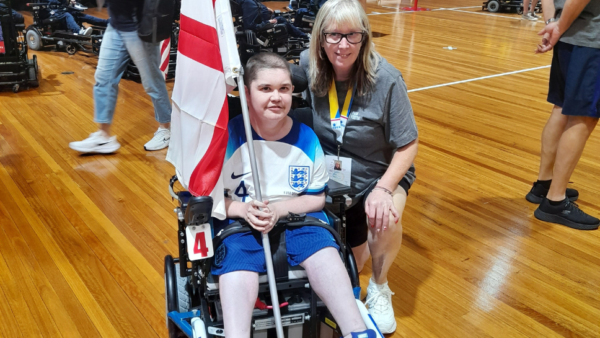
Charley is 21 and lives with limb girdle muscular dystrophy. In recognition of World Mental Health Day, she shares the emotional challenges she faced after diagnosis, and ways she’s found to look after her mental health.
“The hardest part of my diagnosis was my mental health”

I was diagnosed with limb girdle muscular dystrophy type 2A when I was 14. We were told it’s a progressive condition and I’d gradually lose more strength. But at that age, none of it really made sense to me.
All I knew was that I struggled more than others. I wasn’t good at running and I walked on my toes so much that I was given splints to try to correct this (although I hated them and barely wore them). In high school, walking up the three flights of stairs in the science block felt like running a marathon – I’d be so out of breath. But I thought I was just unfit — I never imagined it would be a life-long condition. When we were finally told there was no cure, no treatment, and that it would get worse over time… it felt like the ground disappeared beneath me.
Mental health: the part no one talks about
No one really prepared me for what that diagnosis would do to my mental health. From 14 to 16, I was in a very dark place. I felt like I didn’t want to be here anymore. My mum didn’t know how to help — she’d ask what was wrong, and I didn’t know how to explain that my brain just felt broken. I didn’t want to do anything. I felt worthless.
My anxiety was awful too. I had a period where I could hardly leave the house, and if I did I felt instantly sick. Going out meant worrying about falling over, if my legs were going to give way, and how people would look at me… it was all too much and felt unsafe.
I got support here and there — a psychosocial doctor, a lovely school staff member who always had an open door. Antidepressants helped. But the wider system? It was cold. Within months of my diagnosis, people were telling me I’d need a stairlift, a bungalow, a wheelchair. At that point, I was still walking. I could still run.
No one told me how to process what this meant for my identity — especially as a teenager trying to figure out who I was.
Slowly becoming myself
After school, things began to shift. I realised I didn’t want to go to university, so I did a paralegal apprenticeship instead. Now I’m 21, working full-time, and honestly still figuring it all out. I enjoy law, but psychology has always felt closer to my heart — probably because I know what it feels like to not understand your own mind.
Therapy helped me more than I ever expected. CBT gave me tools to manage thoughts that used to overwhelm me. I started meditating, journaling, practicing gratitude. Of course I’d change my condition in a heartbeat, but I try to think about what I’ve gained from it. Without it, I don’t think I’d be as understanding, resilient, or the one all my friends go to when they have a problem. And I’m grateful for that.
Letting go of shame
For years, I was embarrassed to use any kind of mobility aid. I’d rather exhaust myself walking through the airport, holding onto my mum, than be seen in a wheelchair. But last year, I used one at the airport for the first time — and it was such a relief. I wasn’t tired. I wasn’t panicking. I kicked myself that I hadn’t done it sooner.
I’ve recently started using a cane. It’s helped with balance and reduced my falls. The more I’ve embraced aids, the more I’ve felt free.
A new way of seeing myself
I used to believe my worth was tied to what I could do physically. If I could walk far, stand up on my own, not need help — that meant I was doing well. And if I couldn’t? I felt lazy and broken.
Now I know that’s not true. I’ve fallen over many times and the world didn’t end. It still gets to me sometimes, and that’s ok, but I don’t spend weeks feeling embarrassed by a fall like I used to.
I’ve learned to romanticise life — turning small moments into something magical. Halloween movie nights with themed snacks and PJs. Journaling with my favourite music on. Letting myself feel proud of surviving hard days.
My support system
My mum and brother are my rocks. We’ve had our tough moments — times I felt my mum didn’t understand and I pushed her away. But she’s always been there, and both of them have adapted to this life with me. I don’t know what I’d do without them.
I’ve been very lucky with my friends too. At first, they didn’t always get it — sometimes I wasn’t invited places out of fear I wouldn’t be able to join in. But over time, they learned, just like I did. Now, they Google accessibility, call venues, and always have my back.
What I want you to know
On World Mental Health Day, I just want to say this: if you’re struggling, if you’ve just been diagnosed, or you’re stuck in that in-between space where everything feels unfamiliar, please know that you’re not alone.
Your life still holds value. You’re allowed to grieve, to be angry, to feel lost — but you’re also allowed to find joy again. Mental health isn’t a straight path. Neither is my condition. But over time, you learn to live with it.