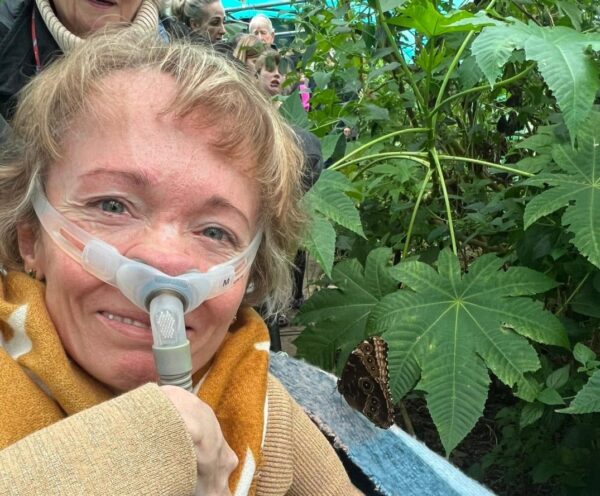
Following the final report of the Timms Review into PIP, Priyaneet, who lives with Charcot-Marie-Tooth disease, reflects on her own experiences and the difference PIP makes to her and others living with a muscle wasting condition.
“For me, PIP is all about independence.”

The news reports and headlines over the past few weeks and months have created a lot of uncertainty for people like me. I may not know all the answers, but what I do know is that conversations around the way the system works need to happen.
I have Charcot-Marie-Tooth disease (CMT) type 4C, which is a lifelong neuromuscular condition. It’s not something that’s going to improve or disappear. So, when changes to things like PIP are discussed, it’s difficult not to think about what that might mean for your independence and ability to continue living your life.
Perceptions of disability
My journey to diagnosis wasn’t straightforward. I was finally diagnosed with CMT in 2012. Before this, there were years of uncertainty and different explanations for what was going on.
One of the things that’s stayed with me is that people often don’t see my disability. I can stand here, have a conversation, run my own business, speak at events and advocate for others. Because of that, people sometimes assume I’m not disabled.
I think we still have quite a narrow perception of what disability looks like. If you don’t fit that image, people can struggle to understand the challenges you face.
Day-to-day life
My condition affects me every day, but not every day looks the same. What many people don’t see is the planning, the fatigue and the impact that living with a lifelong neuromuscular condition has on day-to-day life.
Energy is probably one of the biggest factors in how I manage my life. I’m having to think carefully about what I need to do, where I need to be and where that energy is best spent.
Some days I struggle to get out of bed. There are days when personal care becomes difficult and I need support from my parents. My condition is unpredictable, so how I’m feeling in the morning can be very different to how I’m feeling later in the day.
Before I go anywhere, advance planning is key. I’m often thinking about how I’ll get there, whether there are accessible transport links, whether there’s disabled parking nearby and how much walking might be involved.
Those are things many people don’t need to think about, but for me they’re part of everyday decision-making.
This affects my social life, so I rarely go out independently now because I often need support. Having to make difficult choices about what I can attend because I know there may be a physical cost afterwards.
“I think that’s one of the hidden realities of living with a condition like mine. People see you for a few hours at an event, but they don’t see the planning beforehand or the recovery afterwards.”
For me, independence isn’t about doing everything alone. It’s about having the right support, adjustments and resources in place so I can live my life, contribute to society and do the things that matter to me.
What PIP means to me
For me, PIP is all about independence. It doesn’t remove my disability, but it helps reduce some of the barriers that come with it.
I think sometimes people misunderstand what it is. It’s not a handout. It’s recognising that living with a disability comes with additional challenges and costs that many people never have to think about.
“PIP helps me remain active in my community, run my business and continue contributing to society. It helps with practical things as well, such as transport and getting to medical appointments.”
Going through the PIP process meant having to put all of that into words and explain challenges that aren’t always visible. That can be difficult because you’re talking about some of the hardest parts of your life.
Muscular Dystrophy UK have been by my side for the last 10 years. I was grateful for the support I received during my recent PIP application. Having people who understand neuromuscular conditions and the realities of living with them made a huge difference.
My message to the Government
I would urge the Government to really listen to disabled people. Consult us, learn from our experiences, and involve us in decisions that affect our lives. Every disability is different and not every disability is visible. My condition isn’t something people can always see, but that doesn’t make its impact any less real.
Secondly, focus on removing barriers. From my own experience, accessibility has a huge impact on whether I can participate in everyday life.
When I’m planning where to go, I’m thinking about things that many people don’t have to consider. Is there disabled parking? Is there accessible transport? Can I physically get into the building? Will I be able to access the facilities once I’m there?
If the goal is to help more disabled people into work, then we also need to be asking whether workplaces are accessible and inclusive in the first place.
From my own experience, the right support and accessible environments have enabled me to run a business, contribute to society and do the things that matter to me. That’s where I’d like to see the focus.
Changing the PIP process
The government’s ambition to ‘rehumanise’ PIP is a positive step, and I’d like to see the assessment process more centred around trust and understanding. Use more human language – we are people not robots.
For people like me with lifelong progressive conditions with no cure, it can sometimes feel like you’re repeatedly having to prove something that’s already well documented. That’s why I was pleased to see that, following the Timms Review recommendations, the government has committed to reducing unnecessary reviews for people whose conditions are lifelong, progressive or unlikely to improve.
The assessment process needs to work better for everyone. I’d like to see a better understanding of invisible disabilities. Just because someone presents confidently or has found ways to adapt doesn’t mean the barriers disappear.
Priyaneet featured on Channel 4 News on 24 November, talking about her experience of the PIP assessment. You can watch the feature here.