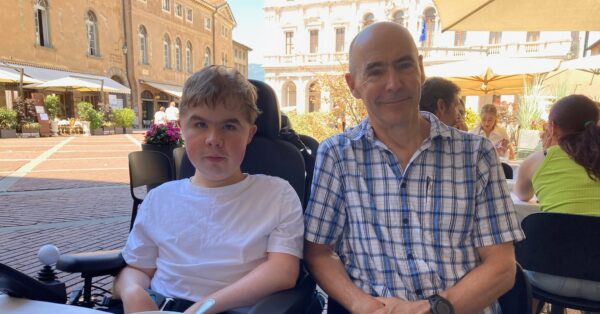
Tilly compares what the SMA treatment and newborn screening was like growing up in America with the current situation in Northern Ireland, having moved there a year ago. She shares how treatment has helped her independence, and the advocacy work she did in America and plans to do here.
“Treatment changed my life – every baby with SMA deserves that chance”

Growing up in Missouri, in America, was very different to now living in Northern Ireland. My dad’s from the UK and with everything going on in the US, we decided to get out of there. I’ve been involved in advocacy work for as long as I can remember, so when I saw how far behind Northern Ireland is for SMA newborn screening, I knew I wanted to challenge that.
I’ve been doing advocacy work for as long as I can remember
I’m 16 and have SMA type 2. I was diagnosed when I was about two and a half. Before that, people thought I was just a late bloomer because I could sit up and roll around, but my legs weren’t really doing what they were meant to do.
“When my family found out I had SMA, a lot of the information they found was really out of date and scary.”
Luckily, we had a great clinic in St. Louis, and they helped us meet other families who actually understood what life with SMA was like. I was involved in advocacy work with the American version of Muscular Dystrophy UK from a very young age. I was even chosen as my state ambassador in 2019, but the pandemic meant I didn’t get to do as much as I wanted.
Starting again in Northern Ireland
Moving country is a lot for anyone, but when you have SMA there’s extra stuff to sort out, like hospital appointments, school, accessibility and making sure you’ve got the right support. So there was a lot to do before our move last year, but I settled in pretty quickly once we were here. I’m the social one in my family, so my parents weren’t too worried about me making friends. Once we had the hospital stuff sorted, I was good at school, and I found a wheelchair football team here too. I’m going into Year 12 now and I’m quite independent at school. I use an electric wheelchair, but mostly I can get around by myself. I might need help opening something, getting stuff out of my bag or picking something up if I drop it, but I’m confident enough to ask.
I’ve seen first hand how newborn screening changes lives
Newborn screening was approved in Missouri when I was seven, and I started a Spinraza clinical trial when I was five, so I know what a difference early diagnosis and treatment can make. I have a friend back in America who was born with SMA type 1.
“Because she was screened as a newborn and started treatment before symptoms showed, she can now walk, jump and run, and only uses a wheelchair when she gets tired. It’s incredible.”
That’s why I find it so shocking that newborn screening still isn’t available in Northern Ireland. It’s one extra blood spot test when a baby’s born, but it can completely change their future. Everyone else around us is starting to move forward with newborn screening, so why aren’t we? We exist in Northern Ireland too.
Treatment has made a massive difference to me. I could lift about half a pound when I started Spinraza. By the end of the trial, when I was about 13 or 14, I could lift four pounds. At that age, I switched to Risdiplam and I still notice little improvements, like having more mobility and being able to do things I couldn’t do before. For me, treatment is about independence, school, wheelchair football and my future. That’s why newborn screening matters so much. If treatment is there and it can help babies before symptoms show, why wouldn’t you give them that chance?
I’m determined to help get SMA Newborn Screening approved here
I want to keep using my voice to help with the campaign here. I met Graham, Muscular Dystrophy UK’s Advocacy and Support Officer, at my first neurology appointment in Northern Ireland. We got talking and I told him about the advocacy work I’d done in America and how I’d love to help here too. Speaking up for people who can’t, or who feel too scared to, has always been a big thing for me. I want to be a solicitor and work in civil rights law when I’m older; use my voice to help others and stand up for people who need someone in their corner.