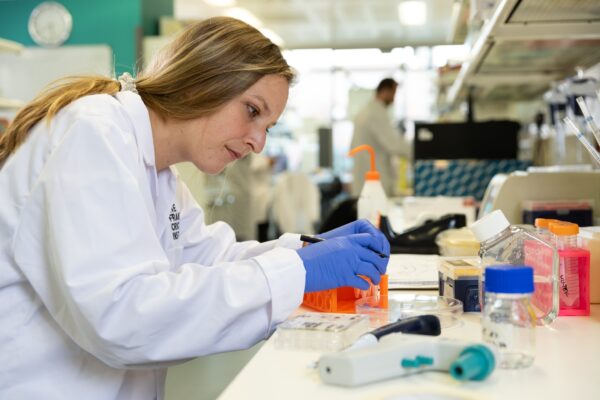
Dr Valeria Di Leo, Associate Researcher at Newcastle University, shares how scientists, including herself, in the UK and Canada have uncovered new clues about how strength training may benefit people with myotonic dystrophy type 1 (DM1). Their work could help shape better exercise support today, and new treatment options tomorrow. The charity funded Dr Valeria’s work in the project.
Does strength training help people with myotonic dystrophy type 1?
17 March 2026

What is myotonic dystrophy?
DM1is a genetic condition caused by a change in a small part of DNA. It can affect many parts of the body, but muscle weakness and tiredness are often the biggest problems. Over time, these changes can make everyday tasks harder.
There are two main types of myotonic dystrophy:
- Type 1 (DM1) – this tends to be the most severe and common type in the UK. Symptoms often start in the face, neck, hands and lower legs. It can also affect the heart and lungs.
- Type 2 (DM2) – for this type, symptoms often start in the hips and thighs but can also affect the heart and lungs.
This research focuses on type 1 (DM1).
Why was this research carried out?
Many people with DM1 find that staying active helps them feel better, both physically and mentally. But we still do not fully understand why exercise helps, or which types of exercise are safest and most useful.
To learn more, I worked with scientists at Newcastle University and the University of Montreal, to study how the muscles of people with DM1 respond to strength training. This could help guide future exercise advice and may also help us understand how to develop new treatments.
Our findings
Across two studies involving men and women with DM1, we found that strength training encouraged muscles to adapt in positive ways.
1. Muscles produced energy more effectively
Strength training helped the “batteries” inside the muscle cells work harder. This gave the muscles more energy, helping them work more smoothly and recover more easily.
2. Muscle fibres showed signs of improved health
In women with DM1, strength training reduced signs of “cell stress.” This means the muscle fibres were working more like muscles from people without DM1 after the programme.
Together, these findings show that DM1 muscles could respond to training in a meaningful and encouraging way.
What did the strength‑training programme involve?
Participants completed a 12‑week training programme, exercising twice a week. Each session included three sets of six to eight repetitions of movements such as squats, leg presses and calf raises.
The exercises used progressive loading, which means the weight increased slowly over time as participants gained strength – each set was followed by a two‑minute rest.
This programme was carefully designed and supervised to make sure participants trained safely.
What are the next stages of the project?
Thanks to funding from Muscular Dystrophy UK, the team are now studying muscle samples donated before and after the training. They are:
- Looking at proteins that are common in skeletal muscle
- Examining thousands of cells from each sample
- Searching for tiny changes caused by strength training
This careful lab work will help scientists discover which changes inside the muscle are most important and which ones might be useful for future research.
How could this research help people living with myotonic dystrophy?
This research is helping us understand much more about how the muscles of people with DM1 react to strength training. While long‑term treatments will take more time to develop, these findings are already helping the team create clearer, evidence‑based exercise advice to support people living with DM1 now.
By learning exactly which exercises lead to positive changes, the researchers can begin building a tailored exercise programme for people with milder symptoms. The aim is to help slow muscle decline and support people to stay strong and independent for longer.
At the same time, the research is giving scientists a better understanding of what happens inside muscle cells during exercise. By finding the pathways involved, the team may be able to identify targets for future treatments. These treatments could one day work alongside exercise or offer similar benefits.
Together, this work will help create practical exercise recommendations for today and support the development of new treatments in the future.
And as we work toward long‑term treatments, exercise, done safely and with support, remains a powerful and accessible tool for many people living with DM1.
More news

Major £1.5m funding boost into muscle wasting conditions
September 2, 2026
Funding new research to understand the scale of neuromuscular conditions
August 18, 2026
A decade of progress: from zero to ten treatments for muscle wasting conditions
May 27, 2026