Women’s Health in Focus: new event spotlights issues and challenges
6 March 2026
On Wednesday 4 March, a few days before International Women’s Day, we hosted our first Women’s Health in Focus event.
We’ve shared stories before highlighting individual’s experiences of facing prejudiced opinions or difficulties in accessing healthcare as a disabled woman, but this event brought these topics to the forefront with two panel discussions.
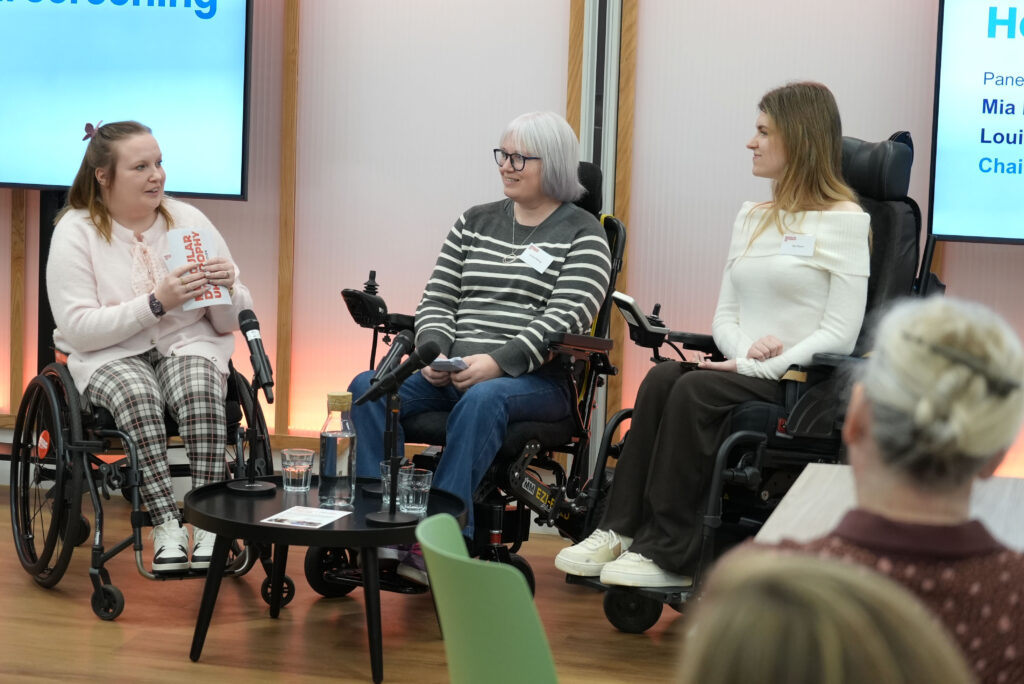
The event took place in London and was attended by clinicians, researchers, and members of our community – providing an opportunity for discussion, to connect with others and reflect on experiences.
Accessibility in women’s health and cervical screening
Chaired by one of our trustees, Chloe Docker, the first panel focused on exploring some of the barriers women with neuromuscular conditions face in accessing women’s health services, especially cervical screening.
PhD researcher Mia Myers spoke about her research and experience, highlighting key issues like inaccessible equipment and inconsistent staff training. She was joined by Louise Halling, a counsellor and psychotherapist who lives with limb girdle muscular dystrophy (LGMD), who shared her own experiences and clinical insight about the psychological impact of inaccessible healthcare and the anxiety it can cause.
“It was an honour to chair a panel at this event, which involved a long overdue discussion about accessibility in women’s health. For many of us living with a neuromuscular condition, accessing these areas of healthcare is mentally and physically harder. Be that accessing the room to start with, not being able to lie down for the procedure, or facing healthcare professionals who just don’t understand. It’s a right not a privilege to access healthcare like this as a woman, and I’m so glad this event discussed such an important topic.”
Chloe Docker
Becca, who lives with spinal muscular atrophy (SMA) also gave a personal reflection on access to cervical screening, including the physical obstacles faced and the consequences of this, which can lead to low screening uptake from women living with a muscle wasting condition or other disability.
Female carriers of dystrophinopathy: The research shaping our understanding
Panel two, chaired by our Research Manager John Copier, focused on another area of concern for women: family planning, particularly for female carriers of dystrophinopathy.
Professor Ros Quinlivan and Dr Anna Sarkozy spoke on the panel, as well as Neeru Naik, who shared her experience of family planning and the impact of being a carrier.
Issues discussed, that particularly relate to carriers, were fatigue, pain or challenges with learning at school, as well as muscle weakness and the importance of checking your heart. It was clear that there’s growing recognition of the need for specific care pathways for carriers, but it remains a complex issue to navigate.
Common themes from the day:
Barriers are systemic, not individual, and exist at every stage of care
Lack of appropriate equipment contributes to low screening uptake
Training for healthcare professionals remains inconsistent
Feeling unheard can lead to stress, avoidance, and fatigue
For carriers of dystrophinopathy, regular cardiac monitoring is important
Everyone deserves to be able to access healthcare without barriers
Access for all
We believe that everyone should be entitled to the same standard of care and education, and it’s essential that health care facilities have the right means in place to deliver their services to women living with disabilities.
Watch this space for more events like this.
We’re here for you
If you’re struggling to access women’s healthcare services, you can contact our helpline for advice.
Checking your chest when you struggle to ‘CoppaFeel!’
Chloe and Becca, who both live with muscle wasting and weakening conditions, share their experiences of checking their breasts. Chloe has been seen at a Breast Care Centre twice and has had to change how she checks her breasts over the years due to the progression of her condition. Becca has never been able to check her own breasts. She shares how she had this discussion with her mum and gives advice on how you can approach your carers for support.
Accessing sexual healthcare as a disabled woman: Lauren and Rebecca’s story
Lauren and Rebecca are both young women who have muscular dystrophy and are full time wheelchair users. For World Health Day, they share their experiences of accessing reproductive and sexual healthcare, reflect on prejudices they’ve faced and what they feel needs to change.