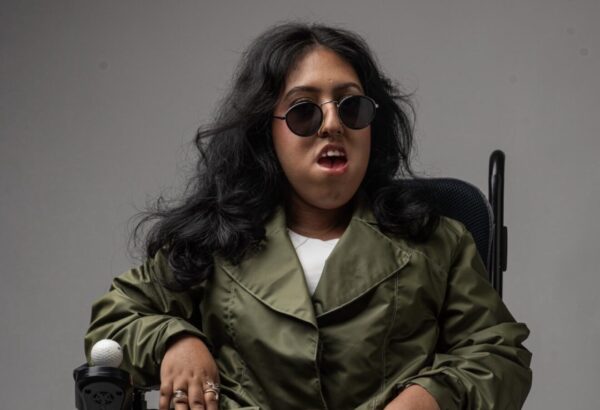
Brooke shares what her life is like with Ulrich muscular dystrophy, the challenges she’s experienced around accessibility, and the importance of compassion.
Travelling, transport and TikTok with Ulrich muscular dystrophy

I’ve lived with Ulrich muscular dystrophy for as long as I can remember. I’m 19 now, and in certain ways I’m just like other young adults: my boyfriend moved in with me and my family last year, I love travelling… but there are a lot of differences too.
My day depends on my pain and fatigue levels
Life with Ulrich comes with challenges that change day to day. Some mornings, I wake up in too much pain to get out of bed. On the better days, I’ll go outside, get some fresh air, maybe do some arts and crafts or binge-watch movies with my mum. I use a CPAP machine at night, and fatigue from pain can be overwhelming, so I’ve learned to listen to my body, even if it means taking naps during the day. That’s just my normal.
“I started college last year but ended up leaving because of bullying. It was a really tough time, but I decided instead of letting it break me, I’d turn it into something meaningful.”
That’s when I started using TikTok to talk about my life – showing how I do things differently, how I travel and raising awareness about what it’s really like living with a disability.
Travelling with an electric wheelchair shouldn’t be this hard
Accessibility sounds simple, but when you live with a disability, you see how much of the world still isn’t built for everyone. Things like dropped kerbs, accessible entrances, and working lifts – they might seem small, but they make a massive difference. I can’t tell you how many times I’ve had to go all the way to the end of my road just to find a dropped kerb so I can get home. Or when a place advertises accessible parking, but the entrance itself has steps.
Traveling is another big one. I love to travel, and I’ve been lucky to go abroad quite a few times to places like Florida and the Canary Islands. But traveling with a wheelchair can be a nightmare. When I was younger and used a manual chair, it was easier. But since switching to an electric chair, it’s become much more complicated.
On one holiday, we found out just two weeks before our trip that my power chair couldn’t go on the plane – it was two centimetres too big. My mum had to buy a foldable power chair for £500. It wasn’t made for my needs, and I actually tipped over in it while we were away.
“Another time, at the airport, staff didn’t have the right details for my chair even though we’d sent them over. They made my dad lift me out of it while they weighed it in front of everyone. It was humiliating.”
Things like that shouldn’t still be happening in 2025. We’re going to Egypt next year and have decided to take my manual wheelchair because of how difficult it is taking my electric one. But it means I’ll have so much less independence which’ll be hard.
Lack of accessibility can ruin a nice day out
Public transport isn’t much better. I usually avoid it because of how unreliable or ignorant people can be. We took a coach recently to get to London. It was fine on the way there, but the lift wouldn’t work when we tried to board to get home. The staff admitted they rarely tested it because not many disabled people use it. It took them 45 minutes to get me on, and then another 45 minutes to get me off when we got home. On the train in London, I got stuck because there was no assistance waiting for me. When we pressed the emergency button, the staff member that responded simply said that his shift had ended so it wasn’t his problem. My dad, brother and boyfriend had to carry me and my wheelchair off the train themselves.
Navigating Ulrich with my boyfriend
I try to keep things as normal as possible. My boyfriend lives with us – we met online a few years ago – and we’ve had to learn how to balance our relationship. I want him to be my boyfriend, not my carer, but he wants to help in whatever way he can. Sometimes it’s hard when I need help but also want independence. Right now, we split my care between my mum and him. We’ve found a rhythm that works for us, and I’m grateful for that.
Kindness costs nothing
Hospitals have been a big part of my life too, and admissions can be made so much more bearable with caring staff. When I was younger and had a chest infection that was turning into pneumonia, I was given medicine that made me sick, and when I started crying, the nurse told me to “stop being overdramatic.” I was only eight years old. Another time after fracturing my femur, I was terrified to move because of the pain, and again I was told to stop overreacting. Those moments stick with you.
But even with everything – the pain, the barriers, the frustration – I try to stay focused on what I can do. I share my story online because I want other people with my condition to know they’re not alone. If my videos or words make even one person feel seen or understood, then it’s worth it.