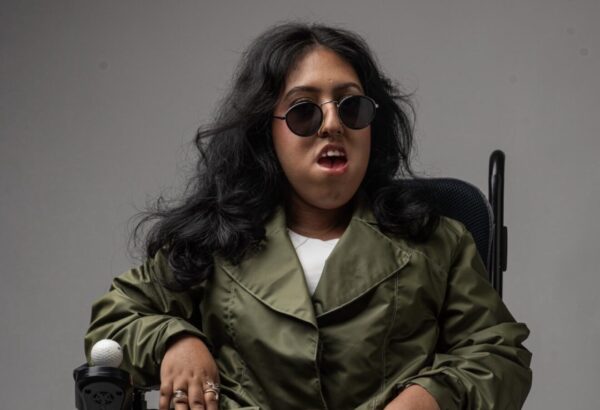
This South Asian Heritage Month, Tahira tells her story about community, representation and living with GNE myopathy as a South Asian woman.
Community, representation and living with GNE myopathy as a South Asian woman

Living with GNE myopathy
South Asian Heritage Month is often a time to celebrate the colour, richness and beauty of our cultures. Food, music, language, family, history, identity – all the things that make up who we are and where we come from.
But for me, it also feels like a moment to ask who is included in that story.
South Asian heritage isn’t only about celebration. It’s also about the quieter things we don’t always speak about openly. Disability. Genetic conditions. Diagnosis. Difference. Strength. These experiences exist in so many families, but are often held privately because people don’t always have the words or know how best to talk about them.
I live with GNE myopathy, a rare genetic muscle wasting condition. It causes progressive weakness and, in my case, began with foot drop, falls and the slow realisation that something was happening in my body that I couldn’t explain.
Today, it affects every part of my life. I wear orthotics from the moment I wake up. I use a walking stick. I think constantly about stairs, kerbs, distances, crowds and whether I’ll be able to move safely from one place to another. It’s changed how I move through the world, how I live, how I parent and how I understand independence.
It’s also changed how I think about community.
The loneliness of rare disease
Rare diseases can be incredibly isolating.
“You can be surrounded by people who love you and still feel that nobody really understands what it’s like to live inside your body.”
For a long time, I felt very alone in that, which is why representation matters so much.
Why this matters for South Asian communities
GNE myopathy is ultra-rare globally, but genomic and clinical studies demonstrate a prominent concentration in South Asia, particularly India, linked to specific ancestral gene variants.
If someone in our community is tripping, falling, developing foot drop or unexplained weakness, they may not know these could be signs of a neuromuscular condition.
“Their family may never have heard of GNE myopathy. Their doctor may not immediately think of it. And if they don’t see South Asian people talking about rare genetic conditions, they may feel like it’s only happening to them.”
That’s a lonely place to be. That’s why awareness, understanding and representation matter.
Breaking the silence
In many South Asian families, there’s so much love. There’s care, protectiveness and a strong instinct to hold each other close. But I think we can sometimes struggle with difference – not because we don’t care, but because we care so deeply and don’t always know what to say or how to help.
Disability and genetic illness can be difficult to talk about. Sometimes silence comes from fear. Sometimes from not wanting to worry others. Sometimes from simply not having the words.
I say this with compassion, not criticism. Silence doesn’t protect people. Information does. Community does. Support does.
Motherhood and GNE
Motherhood has made living with GNE myopathy even more complex. As a mother, you want to do so much: pick your child up without thinking, run after them in the park and manage the everyday chaos. Parenting with a progressive disability means constantly adapting around your body, accepting help before you feel ready and grieving what you can’t do while finding new ways to be fully present.
In South Asian families, mothers are deeply valued but there can also be an expectation – spoken or unspoken – that mothers will carry so much physically, emotionally and practically. I’ve felt that tension – wanting to be the mother I imagined while learning to be the mother my body allows me to be.
For disabled South Asian mothers, this sits at the intersection of gender, culture, family and disability. Women are often expected to be the ones who hold everything together – caregivers, organisers, emotional anchors.
“When your body can’t always meet those expectations, it can bring guilt, misunderstanding and additional pressure.”
There can also be barriers in accessing support, from delayed diagnosis to language and culturally specific gaps in information.
Again, that’s why representation matters. When disabled South Asian mothers are visible, it becomes easier for others to find the words, seek help and feel less alone.
Community as medicine
That’s why I’m grateful for the work Muscular Dystrophy UK is doing, including through the South Asian Neuromuscular WhatsApp Group. Spaces like this make a difference because culturally aware support matters. It’s hugely beneficial to have accessible information and, for those who need it, information in their first language which can be translated by the charity, as well as connect with others who understand.
Community isn’t a cure. But it can be its own kind of medicine.
This South Asian Heritage Month, I want to celebrate the beauty of my incredible heritage. But I also want us to make room for the harder stories – the disabled stories, the rare disease stories and the stories of people living with genetic conditions who may not yet have the words for what’s happening to them. We belong too.

Learn more about GNE myopathy