Dani shares her experience of being a sibling to her brother, John, who lives with Duchenne muscular dystrophy. She writes about the complicated dynamic of this, including growing up together, learning to live with anticipatory grief and guilt, as well as being a carrier of the condition herself.
“I’m here too”: my experience as the sibling of someone with Duchenne

Growing up
John was diagnosed with Duchenne muscular dystrophy before I was born, so I never had a moment of learning about his condition, it was just part of life. And for a long time, I didn’t question it.
As a kid, you don’t question being taken to hospital appointments that aren’t even for you, they just become part of your routine. At one appointment in 2004, I was handed a booklet called ‘I’m Here Too’, with a cartoon family on the front just like mine. I didn’t read it. I just stared at the front cover on the drive home. I finally read it last year, twenty years later and finally saw the pages of questions I hadn’t been ready for aged eight.
Sibling dynamics
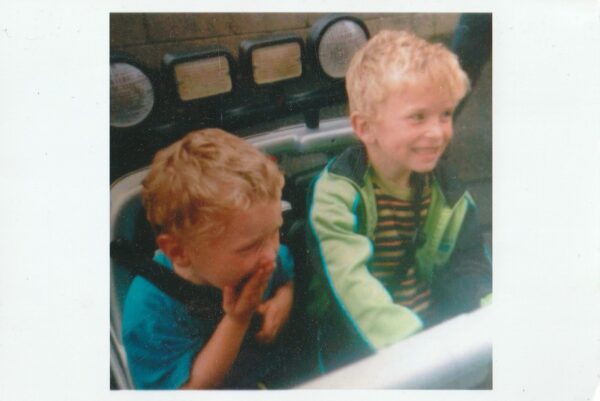
We’re just siblings. Some days we like each other, some days we argue. Even now in our thirties. I remember when John broke his femur at twelve – he wouldn’t let me sign his cast. I was five and a half at the time, which is the perfect age to annoy a 12-year-old boy. But I still hold it against him.
I also remember one time bickering with John and hitting him, only to be told off by my mum – not just because it was wrong, but also because he couldn’t hit me back. That was last time I ever hit him and I’m sure other siblings can understand how infuriating that could feel sometimes!
John went on to break his other femur within two years, so he was in a wheelchair quite early on, by the time I was maybe six or seven.
“I used to blow out birthday candles and wish for him to walk again.”
But that changed as I got older, it changed to wishing for him to be okay.
I think the world of my brother. He’s ridiculously clever, with a photographic memory and the ability to name any country’s flag.
I told people at school he played for Chelsea when he started powerchair football. It confused people, and I loved it. He did play for Chelsea, just the powerchair team, not the one they were picturing. As a Manchester United fan, I’m sure he’d be livid if he knew I was telling people that (sorry John!).
We grew up playing Mario Kart: Double Dash on the GameCube — John driving as Donkey Kong, me on the back as Diddy Kong throwing bananas. With our age gap, he didn’t have to play with me, but he did, and I loved those moments.
Facing ignorance
I’ve witnessed ignorance more times than I can count. People staring, laughing, excluding. A shop worker refusing to let him in because his wheelchair might damage something. A restaurant claiming to be accessible, only for us to find stairs and no suitable toilet.
Even during the Covid-19 pandemic, a man shouted at me and my mum for stepping aside on a narrow path so we could stay safe. Then there were the funny looks we got for still wearing masks when the world ‘went back to normal’. Each time, I felt that familiar sting of frustration.
I’ve learned it’s often ignorance, not malice so now I speak up and have mastered the art of sending complaint emails.
Moments that changed everything
There were moments that reminded me how fragile things could be – nights where I’d wake up to the sound of paramedics in his room. That’s when anticipatory grief crept in slowly. I remember lying awake, hearing paramedics in the house, and convincing myself this was it. That one day, I’d be left completely alone. It wasn’t just about my brother’s health, it was the quiet fear of my parents getting older too.
I didn’t know there was a name for that feeling until much later. Anticipatory grief – grieving someone before they’re gone. It’s not constant, but it lingers. It shapes how I show up, how I love, how I plan.
Not only that but I think I also carry guilt. Guilt for ever feeling sad, for going on holidays to places I know he’d love but can’t visit, for moving out while he’s still at home. Guilt for being able to live more freely. Sometimes even happiness makes me feel guilty, and that’s a strange thing to sit with.
Eventually, after years of being persuaded, I got genetic testing and found out I’m a carrier of Duchenne. My grandmother, mum, two aunts and cousin are all carriers, but John was the first to inherit the condition. I put off the test for years, but working at Muscular Dystrophy UK made me realise I needed to know. It’s changed how I think about the future, about my relationship, about children. But I feel positive. I feel informed.
Nowadays
I go to my family home a lot to see John and my parents. People don’t always understand why, but to me it’s simple; I want to spend as much time with them as possible. When I’m there, John and I catch up over TV shows, films and pub quizzes.
Nothing about this experience has ever fit into neat boxes. I still feel anger, guilt, sadness and pride. It’s shaped how I see the world and how I respond to it – empathetic, aware, emotionally present. I wouldn’t be me without it. Maybe it’s why I feel things deeply, why I’m tuned in to people and why I care the way I do.
It also introduced me to a job at Muscular Dystrophy UK where I’ve met wonderful colleagues, including other siblings of those with muscle wasting conditions for the first time. It helped me realise that so much of what I’ve felt over the years is shared, even if it’s rarely talked about. That’s why I wanted to tell my story, to make others feel less alone. And as the last sentence of the booklet I was given says: keep talking, keep asking and never, ever stop telling people that, hey, I’m here too!