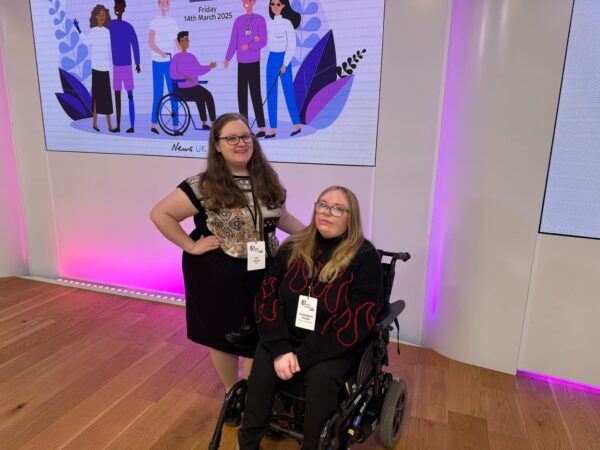
Becca lives with spinal muscular atrophy (SMA) type 2. She shares her reflections on how the treatment landscape has changed in her lifetime, the improvements she’s seen from Risdiplam, and the importance of improving access to treatment for all.
"My parents were told there would never be a treatment for my condition – now there are three"

25 years ago, when I was diagnosed with SMA, my parents were told that never in their lifetime, let alone mine, would there be any treatment for my condition.
Today, there are three treatments for SMA.
In 2021, I started one of these treatments called Risdiplam. When I think back to the prognosis my parents were given, the fact that a treatment exists at all feels remarkable. But it only became available on the NHS after years of campaigning by the SMA community, and years more before hospitals across the country were able to administer it.
For some people, that delay cost them their lives. For everyone else, it meant further progression of their condition.
The fear of my condition progressing never goes away
In society, we measure success by milestones: graduating university, getting your first job, falling in love, buying a home. But when you live with a muscle-wasting condition, every milestone is paired with loss.
When I started school, I lost the ability to breathe on my own at night and had to start using a ventilator. When I finished first school, I lost the ability to sit unaided. When I finished middle school, I lost the ability to lift my elbows off my armrests. And after my first year of high school, I lost the ability to eat solid food.
These are the kinds of losses clinicians recognise as significant. Things that show up clearly on charts and scales during hospital assessments.
But as you get older, the losses become more subtle.
Shortly after graduating university, I lost the ability to type on a standard laptop. When I got my first job, I lost the ability to pick my phone up to my ear.
These changes are harder to quantify. They’re unlikely to appear on a score sheet, and even less likely to be counted when assessing whether a treatment is “working” or “cost effective.”
But everything is relative.
I can probably count on one hand the number of things I can do independently now. That means every further loss matters more. When you have so little left, you’re always on the edge of losing everything.
So what does treatment actually change?
When I started Risdiplam, I didn’t suddenly regain the ability to sit unaided or lift my arms above my head, and I didn’t expect to.
What changed was more subtle. Undetectable to people who didn’t know me well, but remarkable all the same.
Within a few days, my arms felt stronger. I could feel myself breathing more deeply. And I started being able to eat foods I hadn’t managed in nearly a decade due to my weak swallow.
Sometimes the difference was simply having slightly more “strong days,” as I call them, or feeling like I could hug my mum a little tighter.
But for me, and for many others, the biggest weight lifted was knowing that our progression should slow down.
I can’t imagine that assessing whether a treatment is “cost effective” currently involves asking patients whether they can play on the Xbox for longer, hug their loved ones more tightly, or live with less fear of deterioration. But shouldn’t it?
And who knows whether, without that medication, I might have spent a month in hospital that year with pneumonia, at huge personal cost and significant cost to the NHS?
I’ve reached achievements I never believed I would
I know much of what I’ve shared so far focuses on loss, but I want to be clear: I have a truly amazing life. I work full time in a job I love. I live independently in my own rented home. I have the best family and friends I could ever ask for. And my proudest achievement of all is meeting the love of my life, who I’m engaged to and will be marrying next year.
For many able-bodied people, these are milestones they assume they’ll reach at some point. But if you’d told thirteen-year-old me that this is where I’d be at twenty-six, I wouldn’t have believed you.
I owe so much to my parents, who raised me to believe I could achieve anything if I worked hard enough. They never let me feel less than anyone else. But if you’d told them I’d be where I am today, I’m not sure they would have believed it either. I remember the way they looked at me during hospital admissions, through every chest infection and every surgery. Behind their endless encouragement was fear. Fear that I might not even make it to 26, let alone be living the life I am now.
SMA will look completely different for the next generation – as long as we have access to treatments
For many people in the SMA community, the trajectory of our lives is defined by the time period we’re born into.
I am, I hope, among the last generation for whom SMA type 1 is a death sentence and type 2 is life-threatening. But I’m also part of the first generation where, with careful management and medical intervention, people like me can hope to live long and fulfilling lives.
I count my blessings that I wasn’t born into an earlier generation. But I’d be lying if I said I don’t sometimes wonder what my life would look like if I were born today and had received Zolgensma, a life-altering gene therapy for young children.
Unlike me, many of these children will learn to walk and grow up with far greater independence. Unlike me, they won’t carry the trauma of repeated hospital admissions. And unlike me, they may not spend their lives worrying that the next cold could be the one they can’t fight.
That is the power of timely access to treatment.