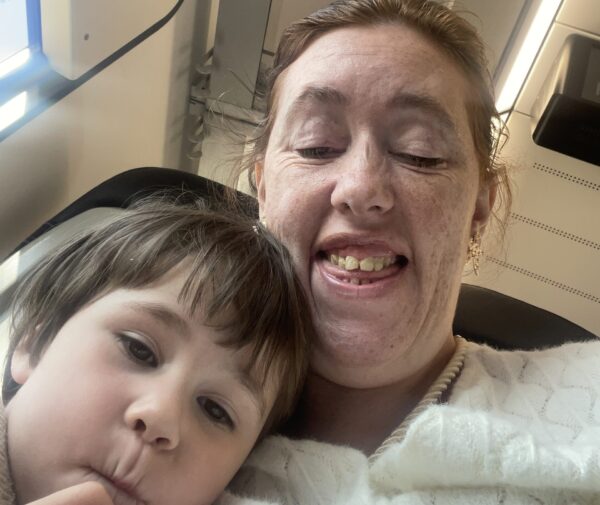
When Susan began experiencing serious heart symptoms, she repeatedly warned doctors about being a manifesting carrier of Duchenne muscular dystrophy. Her concerns continue to be dismissed and misunderstood. She shares the worrying journey she’s on, the lack of support from healthcare professionals, and her advice to other Duchenne carriers.
Doctors don’t seem to care that I’m a manifesting carrier of Duchenne with heart problems

I’ve lived with the knowledge that I carry the Duchenne muscular dystrophy gene for years. Like many women in my position, I had already experienced the devastation this condition can bring. My son, Thomas, died from Duchenne in 2011. So when my own health began to change, I tried to get help. Nobody would accept that my carrier status could be linked to my heart problems.
Early symptoms and missed warning signs
When I injured my back at the beginning of 2022, I was prescribed Amitriptyline after other painkillers not helping. I know now that, as a DMD carrier, I should have had cardiac checks before starting that medication.
In December 2023, I began experiencing palpitations and episodes of tachycardia. My heart would race without warning, leaving me anxious and exhausted. Initial tests came back normal, but I knew enough to question that. Early heart problems don’t always show up on standard tests in DMD carriers.
Dismissed concerns in cardiology care
At my first cardiology appointment in March 2024, I asked for a cardiac MRI, but I was told it wasn’t necessary. That was the beginning of a long and frightening decline.
I found myself repeatedly in and out of hospital, each time explaining that I was a DMD carrier and that my symptoms could be linked. My concerns were brushed aside and I soon started to feel invisible.
Emergency admission and stroke
By the end of March, I was admitted to A&E with a heart rate over 180. I was diagnosed with a narrow complex tachycardia and given Adenosine three times, but it didn’t work.
The whole thing was terrifying. I now know why it didn’t work. Adenosine treats electrical problems in the heart, but mine were likely structural caused by muscle fibrosis. Still, no one questioned it.
I’d still been taking Amitriptyline this whole time and when I raised concerns about this, I was falsely reassured that the dose was too low to matter. I reduced it myself and eventually stopped.
Around this time, I was referred for a possible ablation and advised to take a blood thinner, which I declined, and I now regret that decision. I wasn’t fully informed about the increased stroke risk for DMD carriers.
About a week later, I had a stroke. I was lucky to survive and recover, but it came at a cost. What stayed with me most was the feeling that it might have been avoided if my concerns had been taken seriously earlier.
Ongoing struggle for specialist care
Even after this, I was still not under a specialist neuromuscular cardiology team.
In April 2025, I asked my GP to refer me to a cardiologist with expertise in muscular dystrophy. She couldn’t as I was already under a general cardiologist and that cardiologist refused to refer me on. I felt trapped in a system that had no place for someone like me.
I was eventually referred for a cardiac MRI, but not to a specialist centre. When I later underwent an ablation, I was told again my arrhythmias were unrelated to being a DMD carrier. I knew they were wrong and there was nothing I could do. I was completely powerless.
My condition continued to worsen. By the end of April, medication was no longer controlling my heart rhythm and I required cardioversion. When that didn’t hold, I was offered two options: a pacemaker or a powerful drug with serious risks. I chose the pacemaker which they fitted in May 2025. A referral to a specialist centre was finally made in October 2025, but I am still waiting to be seen.
Living with unanswered results
In the meantime, I discovered through my NHS app that my cardiac MRI showed signs of cardiomyopathy. No one had told me. I found out alone, reading a report on my phone. This was proof my heart issues were related to being a DMD carrier, yet everyone had ignored it.
When my medication stopped working, my GP refused to prescribe an alternative without cardiology approval. As I was in limbo waiting to be seen by the new cardiologist I’d been referred to, they couldn’t get hold of anyone. With nowhere else to turn, I had to turn up unannounced to my former cardiologist’s clinic and beg for help. It should never have come to this.
Throughout this journey, I have felt isolated and responsible for coordinating my own care. There are treatments that can slow the progression of heart disease in DMD carriers, but only if you are seen by the right specialists at the right time.
Why I am sharing my story
No woman who carries the DMD gene should have to fight this hard to be heard. If I could say one thing to other carriers, it would be to not wait until things are bad. Even if you feel well, ask to be referred to a specialist cardiologist. Push for a cardiac MRI. Don’t rely on reassurance from tests that cannot see the full picture.
If sharing my story helps even one woman be taken seriously sooner, it will have been worth it.
Despite everything, I try to look at the positives in life. One of my daughters isn’t a carrier and she recently gave birth to my first grandson. He’s the first boy in four generations of our family to be born without Duchenne muscular dystrophy.