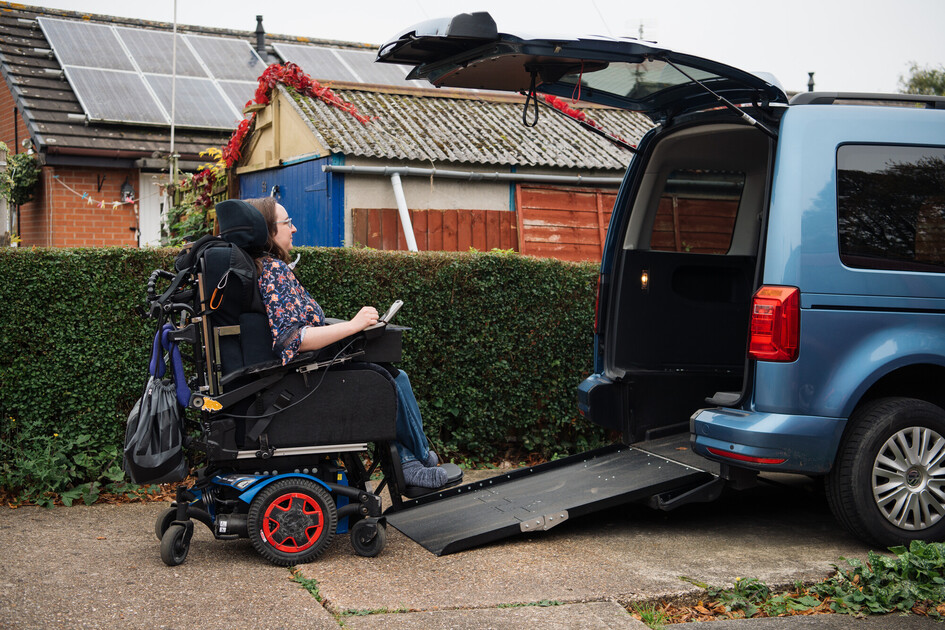
Driving Independence: What the Motability Scheme means to our community
27 October 2026
Tax changes in last year’s Autumn Budget led to some changes in the Motability Scheme from 1 July 2026, including reduced mileage allowance and higher excess mileage fees.
As we approach the Autumn Budget 2026, we look at the Motability Scheme – how it works, some of the myths, and what it means to our community.
What is the Motability Scheme and how does it work?
Often described as ‘a lifeline’, the Motability Scheme enables people receiving a qualifying disability benefit to lease a car, Wheelchair Accessible Vehicle (WAV), scooter, or powered wheelchair using the mobility component of their allowance.
The allowance is paid directly to the Motability Scheme and typically covers supplying the vehicle, insurance, servicing, maintenance, and breakdown cover.
However, not all vehicles are covered fully by the weekly mobility allowance. If you require a larger, higher-specification vehicle to accommodate a wheelchair and adaptations, for example, an additional advance payment will be needed. Standard car leases typically last for three years, while WAV leases last for five years.
What has changed recently?
In last year’s Autumn Budget, the UK Government announced tax changes that affected the Motability Scheme. Prior to this, there was no VAT or Insurance Premium Tax on most Scheme leases, but from 1 July 2026, new vehicle orders were subject to 20% VAT on Advance Payments, excess mileage and most other payments outside the mobility allowance (excluding those meeting HMRC’s disability exemption criteria).
These changes meant that it would cost more to run the Scheme. To manage rising costs and maintain affordability, the Motability Scheme made some changes for new orders placed from 1 July 2026. These include refining the vehicle range to prioritise affordability, halving the annual mileage allowance to 10,000 miles per year, and increasing the excess mileage charge from 5p to 25p per mile.
Other changes include fewer tyre replacements and a £22 administration fee for EU breakdown cover. All leases continue to include insurance, servicing, maintenance and UK breakdown cover.
Misinformation vs Reality
We know from speaking to people in our community, that there are a lot of misconceptions about the Motability Scheme. Misinformation is becoming increasingly common, especially across social media. We’d like to clarify two points:
It is not a free car: Motability cars are not free; they are leased using an individual’s qualifying mobility allowance. Many vehicles also require an upfront payment which must be met by the individual. Like Blue Badges, Motability vehicles exist purely to help achieve equitable participation in society – not as a perk, but as a necessity.
Eligibility requirements apply: An individual must already have been awarded a qualifying mobility benefit, usually the enhanced mobility component of PIP, through a government assessment process. Eligibility for the Scheme is based on the impact a condition has on a person’s mobility and ability to travel safely and independently.
It’s more than a car
Martin Hywood lives with limb girdle muscular dystrophy and leases a Wheelchair Accessible Vehicle (WAV) through the Motability Scheme. Having this vehicle enables him to carry out essential day-to-day activities, such as going to work, accessing healthcare, and spending time with family and friends. Martin explains what the Motability Scheme and his WAV mean to him:
“The Motability Scheme is one of the few systems that reduces barriers, prevents isolation, and supports independence and employment. I feel sad that there’s so much misinformation out there about it, and that people are being questioned about something that’s so fundamental to their lives. My WAV is not a free car – I made an upfront payment, and it’s leased using my mobility allowance. It is not a luxury item – it enables me to do things that otherwise wouldn’t be possible, including being in full-time employment, which means I can contribute to society by paying tax and helping others.
Without a WAV, I’d be isolated. Unable to move, my condition would progress faster. My mental wellbeing would be impacted. It’s a cog in my life that keeps my life moving. Without it, my life simply wouldn’t work.
Some people describe the Motability Scheme as a lifeline. I think it’s bigger than that.”
Martin Hywood
Next steps
The Autumn Budget 2026 is coming out on Wednesday 28 October, and this will be followed next month by the final report of the Timms Review into PIP and the Milburn Report on young people and work. We will be analysing all of these to see how they will affect our community and will provide updates here and on our social media channels.
Find out more about our campaigning work on welfare and employment